

Innovative Business Ideas for UK Innovator Visa That Get Endorsed
The UK Innovator Founder Visa has quickly become one of the most attractive pathways for entrepreneurs who want to launch and scale their businesses in Britain. For many ambitious founders, the biggest challenge is not just securing the visa but developing business ideas for UK Innovator visa applications that truly stand out and attract the endorsing body’s attention.
Why Choosing the Right Business Idea Matters for the UK Innovator Visa
The Innovator Founder Visa is not just about relocating to the UK—it’s about launching a sustainable business that is innovative, scalable, and viable. To qualify, applicants must prove that their business:
- Introduces something genuinely innovative to the UK market.
- Has the potential to scale regionally and internationally.
- Can generate employment opportunities and economic growth.
A compelling idea is the foundation. But beyond the immigration requirements, it must also appeal to endorsing bodies who will support your journey with expertise and strategic advice.
This is where a professionally written innovator founder visa business plan becomes critical. With support from TOP Writers, entrepreneurs can translate their ideas into a structured, evidence-backed plan that endorsing bodies take seriously.
How to Prove Your Innovator Founder Visa Business Idea is Innovative?
Innovation is central to the Innovator Founder Visa, and applicants must prove that their idea is not only new but also meaningful, defensible, and impactful. Endorsing bodies want to see ventures that introduce originality, solve genuine problems, and create value in ways existing businesses have not. Strong innovation is usually backed by research and development, requires specialist expertise, and is driven directly by the founder rather than outsourced entirely. Weak innovation, by contrast, often addresses superficial needs, involves minor tweaks, or can be easily copied by competitors.
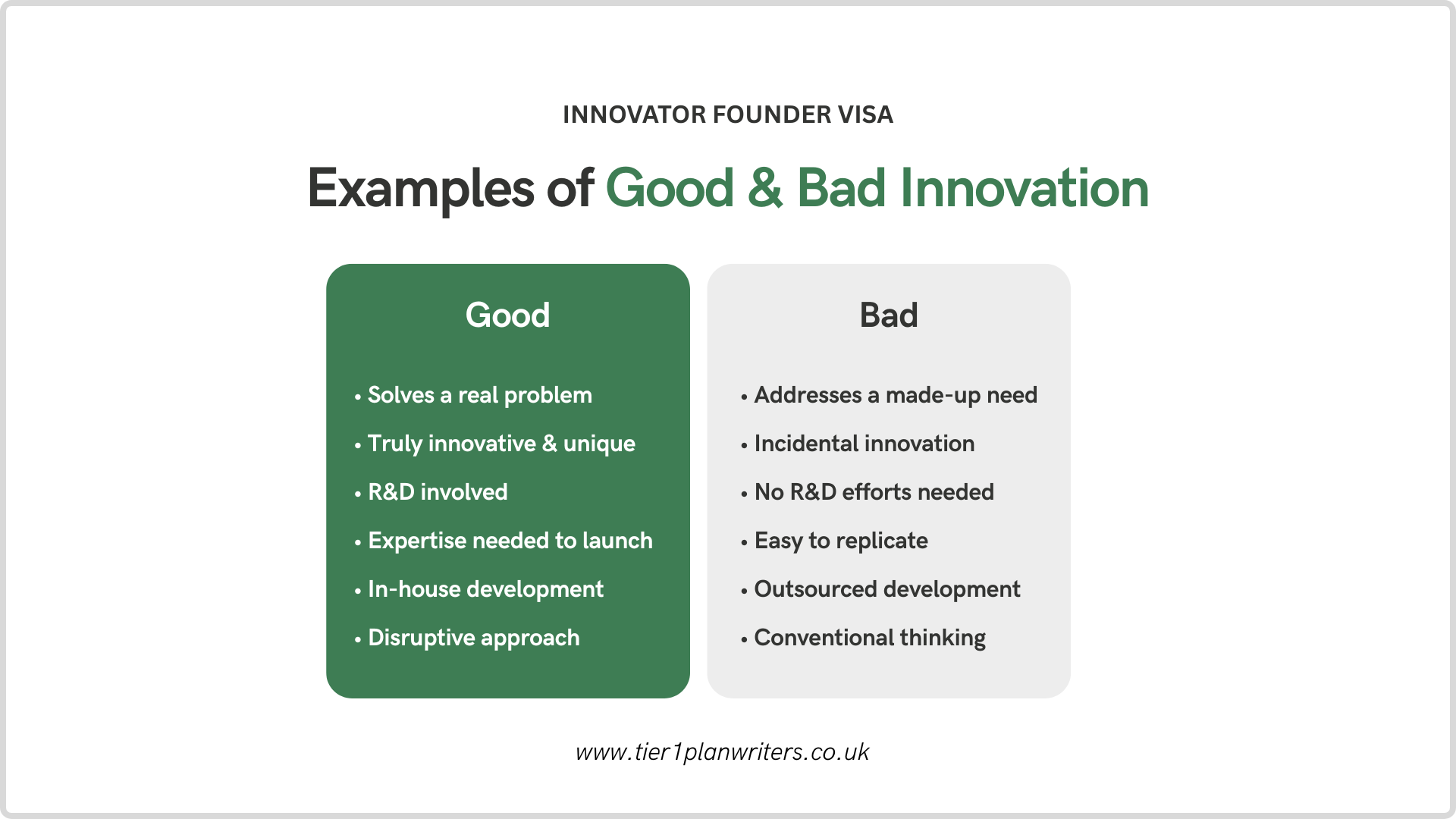
- Problem Solving vsMade-up Needs – A strong innovation identifies a real pain point and offers a practical solution that customers are looking for, while a weak idea often targets problems that do not exist or matter little to the market.
- Originality vs Superficial Tweaks – Good innovation creates something new or different from what competitors provide, whereas weak ideas only make minor adjustments to existing products or services without adding real value.
- R&D-driven vs No Development – Innovative businesses usually invest time and resources into research, prototyping, or testing, proving that the idea has depth. Weak concepts, by contrast, require little to no development and can be launched without effort.
- Expertise-led vs Generic Skills – Endorsing bodies expect the founder to have the subject matter expertise to deliver on the proposed business venture. A weak proposal could be executed by anyone with basic resources, showing no specialist input.
- In-house Leadership vs Outsourcing – Strong innovation is built and refined under the applicant’s own direction, showing ownership of the idea. Weak ideas are entirely outsourced, suggesting the applicant is not the real innovator.
- Disruptive Change vs Conventional Thinking – The best innovations challenge industry norms, introduce fresh methods, or reshape customer experiences. Weak innovations simply repeat existing models without shifting the market in any meaningful way.
In short, the innovation test is about proving that your business idea falls on the stronger side of these comparisons—unique, credible, and transformative. Applicants who can clearly show this distinction in their business plan stand a far greater chance of securing endorsement.
How to Prove Your Innovative Business Idea for UK Innovator Visa is Viable?
Viability refers to whether your business can realistically succeed in the UK market. It is not enough to have an innovative idea; endorsing bodies must also be convinced that the business can be delivered, sustained, and grown by the applicant. A viable business shows commercial potential, credible financial planning, and a strong link between the founder’s expertise and the project’s requirements.
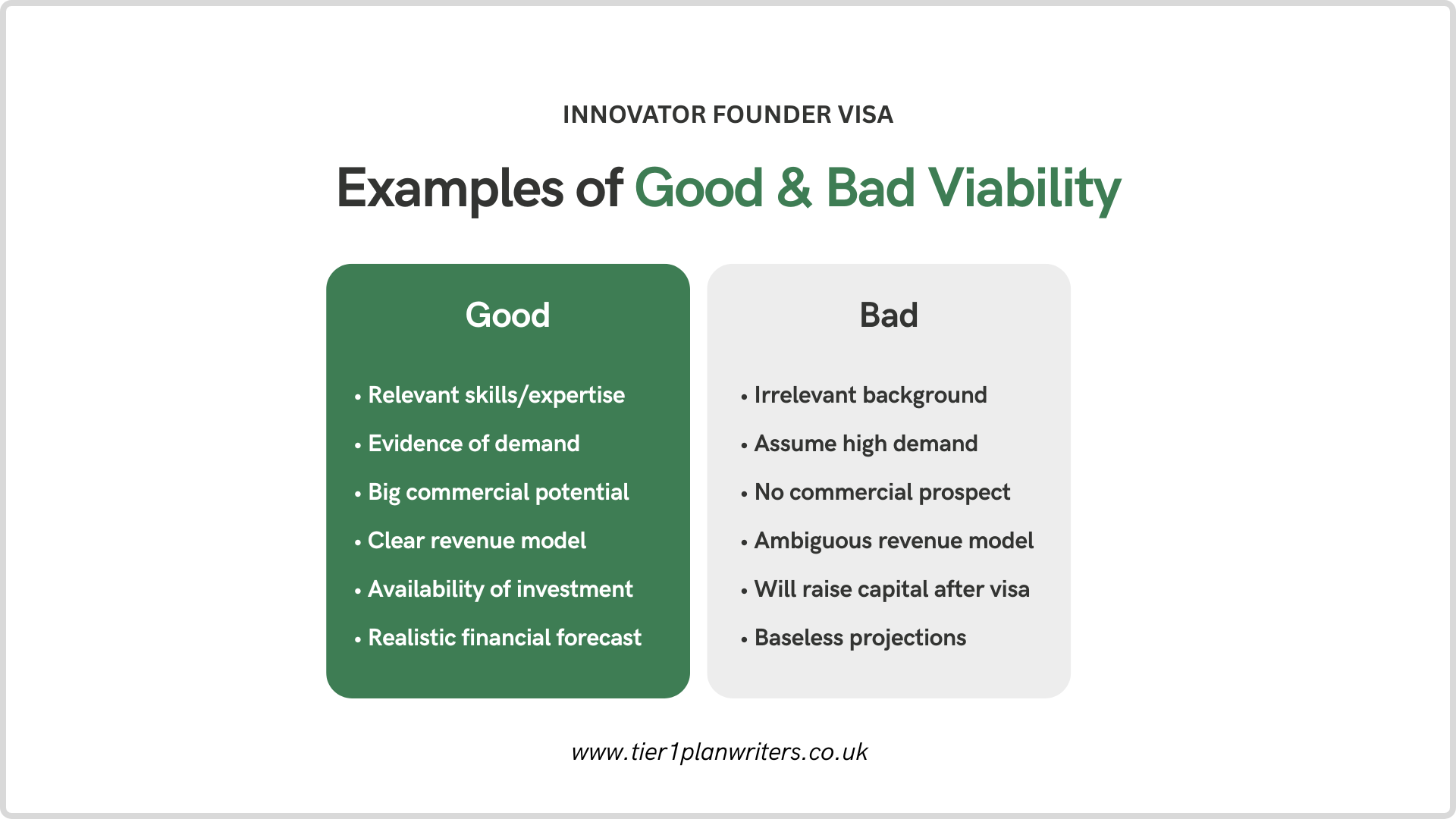
- Relevant Skills vs Irrelevant Background – A viable business is led by a founder or founding team whose knowledge, skills and experience match the industry, while an irrelevant background raises doubts about the ability to execute.
- Evidence of Demand vs Assumed Demand – Good applications provide proof of market need, such as research, surveys, or letters of interest, while weak ones simply assume customers will buy.
- Commercial Potential vs No Prospect – A strong plan shows how the business can generate revenue and scale, whereas a poor one lacks realistic pathways to profitability.
- Clear Revenue Model vs Ambiguous Model – Endorsing bodies expect a straightforward explanation of how money will be made, unlike vague or confusing models. This includes showing your sustainable pricing model that can help you make and maximize revenue.
- Availability of Investment vs Dependent on Future Capital – A viable business idea proves sufficiency and availability of funds in the founder’s own or onboarded investor’s account with a commitment letter, while weak plans rely solely on raising funds after the visa is granted.
- Realistic Forecasts vs Baseless Projections – Good viability is backed by grounded financial forecasts with research and assumptions, unlike overly optimistic or speculative numbers.
In short, viability is about credibility. It reassures endorsing bodies that the founder has the right background, the business has real demand, and the financials are achievable. Without proving viability, even an innovative idea will not pass endorsement.
How to Prove Innovative Business Idea for UK Innovator Visa is Scalable?
Scalability is the third mandatory requirement to prove in your innovative business idea. It refers to the ability of a business to grow, expand, and generate increasing returns without being restricted by rigid structures or excessive costs. For the Innovator Founder Visa, endorsing bodies want to see that your business has the potential not only to succeed at a small scale but also to grow sustainably across larger markets, potentially even at an international level.
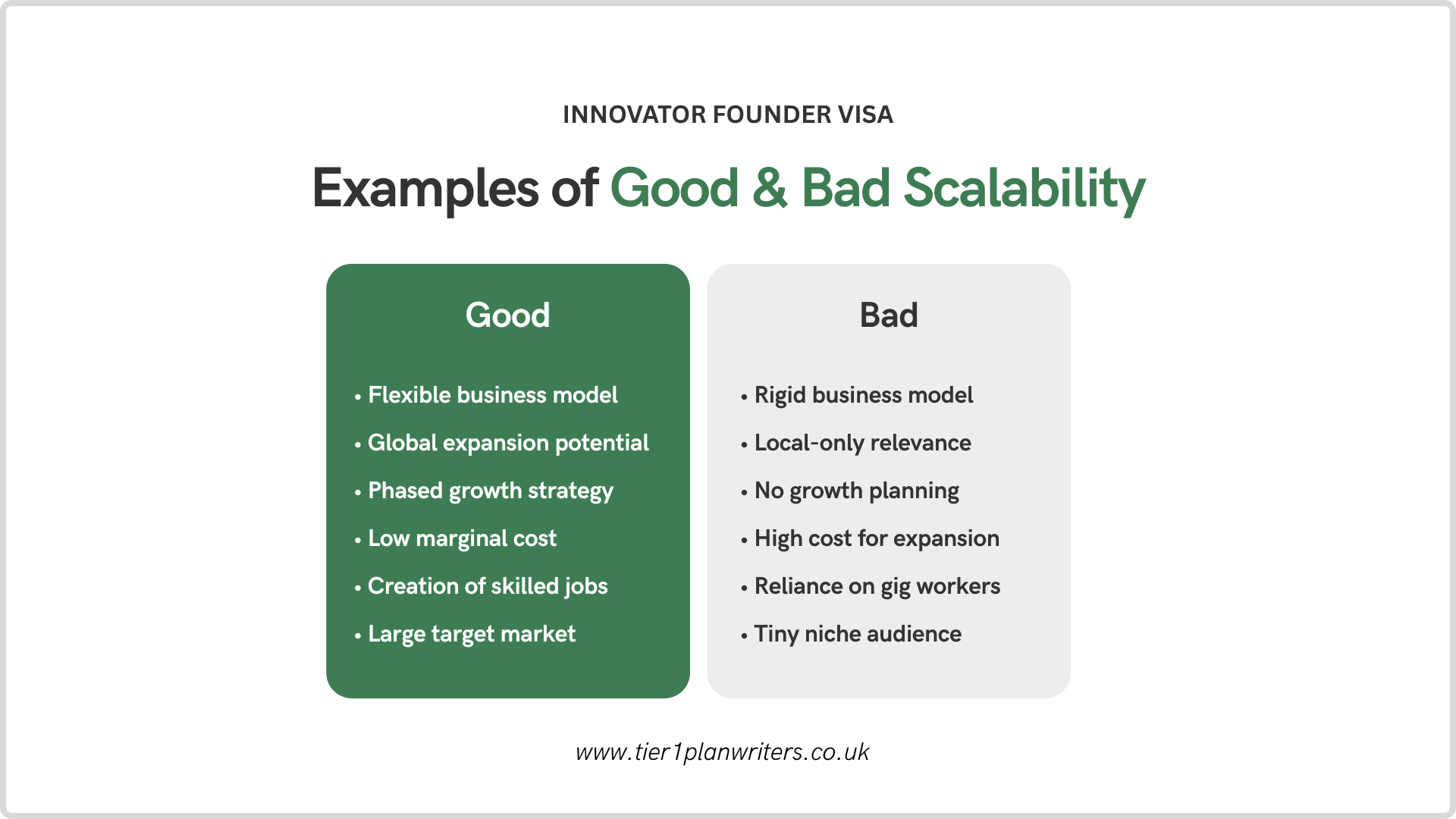
- Flexible Business Model vs Rigid Model – Scalable businesses can adapt to new markets, technologies, or customer needs, while rigid models limit growth opportunities.
- Global Expansion Potential vs Local-Only Relevance – Strong plans demonstrate how the business can expand beyond one location or region, whereas weak ones only apply to a small, local context.
- Phased Growth Strategy vs No Growth Planning – A scalable venture outlines a step-by-step plan for expansion, while an unscalable one shows no roadmap for growth.
- Low Marginal Cost vs High Cost for Expansion – Successful scalable businesses can grow without costs rising in proportion to revenue, unlike models where each expansion requires heavy investment.
- Creation of Skilled Jobs vs Reliance on Gig Workers – Endorsing bodies value businesses that generate ongoing, high-quality employment rather than short-term, low-skilled roles.
- Large Target Market vs Tiny Niche Audience – A scalable business addresses a wide or growing market, unlike ideas limited to a narrow audience with little room for expansion.
In essence, scalability is about proving that your venture can grow sustainably, create skilled employment, and expand beyond its initial scope. Endorsing bodies look for evidence that your business is not a one-off idea with local limitations, but a model capable of long-term, large-scale impact in the UK and beyond.
Examples of Innovative Business Ideas for UK Innovator Visa Applicants
Here are some innovative and endorsement business ideas for UK Innovator visa applications that align with current UK market trends.
1. Green Tech and Sustainable Energy Solutions
The UK is strongly committed to reaching net-zero carbon emissions by 2050. This has created enormous opportunities for startups in renewable energy, waste management, carbon capture, and sustainable consumer products.
- Example of an innovative business idea:
- AI-powered energy efficiency platforms for businesses.
- Urban farming and vertical agriculture solutions.
- Biodegradable packaging and sustainable e-commerce models.
Investors are actively funding companies that can combine profitability with social and environmental impact. Presenting your business as a scalable green tech solution is a powerful way to stand out in the Innovator Founder Visa application process.
2. FinTech and Digital Banking Platforms
The UK, especially London, is a global hub for financial innovation. From blockchain-based payment systems to AI-driven financial advisory platforms, FinTech remains one of the most attractive sectors for endorsing bodies.
- Example of an innovative business idea:
- Peer-to-peer lending platforms.
- Digital wallets for underserved communities.
- RegTech (regulatory technology) for compliance automation.
When combined with a clear roadmap in your innovator founder visa business plan, FinTech ideas demonstrate both innovation and strong scalability potential.
3. HealthTech and Biotech Innovations
The pandemic has accelerated innovation in healthcare technology, making HealthTech one of the most attractive sectors in the UK.
- Example of an innovative business idea:
- Remote patient monitoring platforms.
- AI-driven diagnostic tools.
- Wearable medical devices for chronic condition management.
With the NHS open to digital transformation partnerships, this space offers incredible potential for entrepreneurs who want to build sustainable businesses while addressing real social needs.
4. EdTech and Digital Learning Platforms
The rise of remote work and digital education has made EdTech one of the fastest-growing industries. The UK education system is highly receptive to digital innovation, creating opportunities for founders.
- Example of an innovative business idea:
- AI-driven tutoring platforms.
- VR-based immersive learning environments.
- Upskilling platforms for corporate employees.
EdTech businesses offer high scalability and global reach, making them ideal business ideas for UK Innovator visa applicants.
5. AI and Data-Driven Business Solutions
Artificial intelligence and machine learning have applications across every sector—finance, logistics, healthcare, marketing, and more.
- Example of an innovative business idea:
- Predictive analytics for supply chains.
- AI-powered recruitment platforms.
- Machine learning solutions for fraud detection.
Endorsing bodiesare eager to back startups that leverage AI not just as a buzzword but as a core driver of efficiency and profitability.
6. E-Commerce Niches with a Sustainability Angle
The UK e-commerce market is worth billions, but niche, sustainable, and ethical brands are capturing growing market share.
- Example of an innovativebusiness idea:
- Eco-friendly lifestyle products.
- Subscription models for zero-waste household items.
- Circular economy platforms for re-commerce.
By combining e-commerce with innovation and sustainability, entrepreneurs can demonstrate both creativity and commercial scalability.
Common Mistakes to Avoid in Your Innovative Business Idea for UK Innovator Visa
When preparing an application for the Innovator Founder Visa, many entrepreneurs focus heavily on their idea but overlook how it is evaluated against the Home Office’s key benchmarks. Even promising ventures can be rejected if the business plan is poorly structured or misses critical details. Below are common mistakes to avoid when shaping your innovative business idea:
- Choosing a generic or saturated concept – Endorsing bodies are not impressed by ideas that already exist in abundance or lack originality. Your business must stand out with a clear innovative edge. It shall strive to create a “new” niche market segmentinstead of competing with existing brands for a market share in the “existing” market.
- Overlooking founder expertise – A business plan must demonstrate that the applicant has the right skills, background, or industry experience to deliver the idea. Without this credibility, even strong ideas appear weak.
- Ignoring financial strength – Many applicants underestimate the importance of showing adequate start-up capital and sound financial planning. Weak funding signals low viability.
- Neglecting scalability – Innovation alone is not enough. Endorsing bodies want to see how your business can grow, create jobs, and expand beyond small local markets. Lack of a clear growth strategy often leads to rejection.
- Disregarding compliance and regulation – Whether sector-specific licences, legal obligations, or data protections, compliance must be built into the plan. Failure to address these makes the proposal appear incomplete and risky.
By avoiding these pitfalls, you can position your business idea as genuinely innovative, viable, and scalable—greatly improving your chances of winning endorsement for the UK Innovator Visa.
How to Transition an Innovative Business Idea into a Strong Innovator Founder Visa Business Plan
Having an innovative idea is only the starting point. To succeed with the UK Innovator Founder Visa, you must translate that idea into a structured, well-researched business plan that meets endorsement standards. A strong plan does more than describe the concept—it proves that it is innovative, viable, and scalable.
The transition begins by defining the problem and solution clearly, showing how your idea addresses a genuine market need. From there, you should support the innovation with evidence, such as market research, competitor analysis, or proof of concept, to demonstrate that the idea is both unique and defensible. Next, build credibility around the founder’s expertise—highlight your skills, background, and any strategic partners who strengthen your ability to execute the plan.
Financials are equally important. A strong business plan includes realistic projections, a clear revenue model, and evidence of available capital. This demonstrates viability and reassures endorsing bodies that the business is not just innovative but also financially sustainable. To meet the scalability requirement, lay out a phased growth strategy that shows how the business can expand nationally and internationally, create skilled jobs, and capture a large enough market.
Finally, ensure that your plan addresses compliance and regulatory obligations from the outset, as overlooking these weakens credibility. By combining innovation with structured planning, financial grounding, and growth potential, you transform your business idea into a plan that is not only compelling but also endorsement-ready.
How TOP Writers Supports Innovator Founder Visa Applicants
At TOP Writers, we understand that successful visa applications require more than just a good idea. They require a structured, persuasive innovator founder visa business plan backed by evidence and tailored to UK standards.
Our services include:
- Business idea and founder’s profile assessment.
- Advisory services to refine and align your business idea with the requirements.
- Preparing a well-structured Innovator Founder Visa Business Plan.
- Preparing your endorsement pack and submitting the endorsement application.
- Working with you until you obtain the endorsement letter.
- Extending the visa application in conjunction with a qualified, IAA-registered solicitor.
By bridging the gap between immigration requirements and business realities, we help entrepreneurs launch innovative businesses that thrive in the UK.
About the Author
 Faisal Malik is a business planning expert with over 15 years of experience, specialising in UK Innovator Founder Visa business plans. As the founder of Tier 1 Plan Writers (TOP Writers), he has delivered more than 1,000 plans—both independently and in collaboration with leading Legal 500 law firms across the UK. His work is widely recognised by law firms and endorsing bodies, where he is often referred to as “the best business planner.” Checkout Faisal Malik’s detailed profile for more information on his career.


Leave a Reply
Want to join the discussion?Feel free to contribute!